

AI PRODUCT PHOTOGRAPHY AND VIDEO FOR ECOMMERCE BRANDS.
Turn approved product references into ecommerce-ready catalog images, on-model fashion photography, campaign creative, and short product videos—guided by art direction and reviewed for product fidelity.
- Product-fidelity controls
- Multi-asset media sets
- Storefront-ready delivery
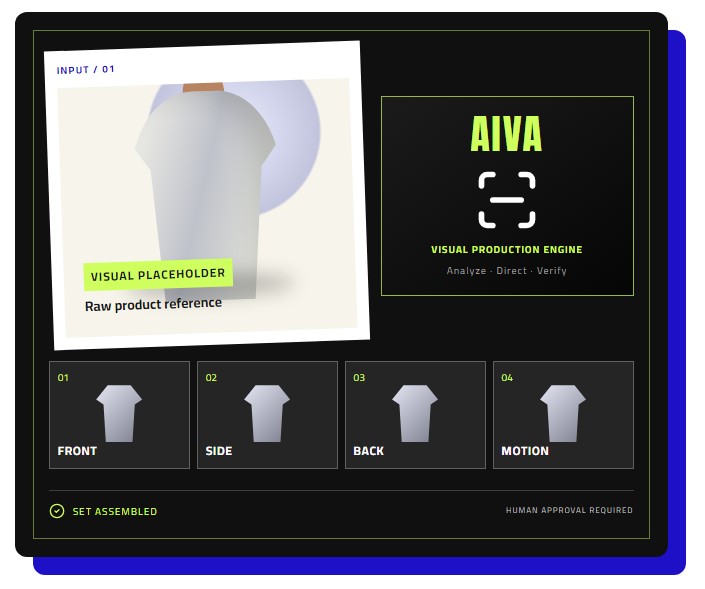
Your store may not need more traffic. It may need fewer reasons not to buy.
AI product photography uses generative image technology to create or transform ecommerce visuals from approved product references. Outputs can include studio images, lifestyle scenes, on-model fashion photography, campaign variations, and short product videos.
AIVA is ABECODS’ managed AI visual-production service. Unlike a self-service image generator, the workflow combines source assessment, creative direction, controlled generation, product-fidelity review, human approval, and organized delivery.
AIVA / DEFINED
AI VISUAL CONTENT, MANAGED FOR COMMERCE.
A branded production system—not the keyword customers need to know before they find us.
THE CATALOG KEEPS MOVING. VISUAL PRODUCTION DOESN’T.
New products wait for usable media
Listings arrive before the complete set of angles, crops, and motion needed to present them with confidence.
Every shoot starts from zero
Models, locations, lighting, post-production, and channel variants create the same coordination burden for every drop.
Fast AI output drifts from the product
A beautiful image still fails when color, cut, texture, construction, or brand direction no longer matches what the customer receives.
AIVA is built for the space between “generate an image” and release production-ready ecommerce media.
HOW OUR MANAGED AI VISUAL PRODUCTION PROCESS WORKS.
ABECODS combines AI image generation with art direction, product specifications, quality gates, human approval, and ecommerce delivery.
Analyze the product
AIVA reads the source images, product details, material, construction, and available angles before any scene is generated.
Direct the visual system
ABECODS defines the model, setting, lens, lighting, crop, and media sequence so every output belongs to the same brand world.
Verify product fidelity
Generated outputs are checked against the catalog reference. Color, cut, construction, texture, anatomy, and image artifacts are hard gates.
Organize and publish
Approved assets are prepared in the correct order and format for product galleries, campaign pages, social content, or ads.
AI PRODUCT IMAGES FOR EVERY ECOMMERCE TOUCHPOINT.
ABECODS combines AI image generation with art direction, product specifications, quality gates, human approval, and ecommerce delivery.
Input / directed output
Replace this component with one approved, traceable product example. The product must remain demonstrably consistent across both states.
- Source reference
- AIVA output


AI PRODUCT IMAGES FOR EVERY ECOMMERCE TOUCHPOINT.
A media set that helps shoppers inspect the product.
Lead with the strongest hero, then answer fit and construction questions with consistent supporting angles and motion.
- ✓ Front hero image
- ✓ Side profile
- ✓ Back construction
- ✓ Seamless-loop video
A campaign world built around the real product.
Extend approved products into directed editorial scenes while maintaining the visual cues that make the item recognizable.
- ✓ Hero scene
- ✓ Editorial crop set
- ✓ Collection composition
- ✓ Responsive variants
Platform-ready creative without rebuilding every format.
Plan the crop, safe zones, and sequence early so one concept can travel across feed, Story, and short-form placements.
- ✓ 4:5 feed visual
- ✓ 9:16 Story frame
- ✓ Carousel details
- ✓ Campaign cutdowns
Short motion that reveals, rather than distracts.
Use controlled turns, fabric movement, or product interaction to reveal details that static imagery cannot show clearly.
- ✓ Looping product turn
- ✓ Motion keyframes
- ✓ Vertical video crop
- ✓ Poster frame
CONNECT AI PRODUCT CONTENT TO THE REST OF THE GROWTH SYSTEM.
Visual production works best when the asset format, storefront, campaign use, measurement, and publishing workflow are planned together.
Shopify & WooCommerce development
Place approved product imagery and video into a clear, performant gallery system.
Performance marketing & PPC
Plan campaign crops and creative variations around real placement requirements.
Analytics & conversion tracking
Measure how visual changes affect engagement, product-page behavior, and qualified actions.
AI agents & ecommerce automation
Coordinate approved production, review, organization, and delivery workflows.
CREATE ON-MODEL PRODUCT IMAGERY WITH CONTROLLED CASTING AND DIRECTION.
AI fashion photography can transform approved flat lays, mannequin shots, or existing catalog images into directed on-model visuals. The production brief defines model profile, styling, pose, setting, lighting, and crop before outputs enter review.
For MENA-focused brands, casting and visual direction can be planned around the audience, market, product category, and approved brand standards—subject to a source-readiness and creative assessment.
- On-model apparel and accessory imagery
- Consistent model and campaign direction
- Front, side, back, and detail continuity
- Product-fidelity review before release
HOW WE REVIEW PRODUCT FIDELITY AND VISUAL QUALITY.
Product fidelity means checking generated imagery against approved references for visible attributes such as shape, construction, color, material, pattern, logos, and distinguishing details. An attractive image does not pass when the product is wrong.
Observable baseline
Details visible in the source are documented before generation. Details that cannot be verified are never assumed.
Independent review
Quality assurance is separated from generation so the creative output does not approve itself.
Human release decision
The final media set remains subject to agreed human approval before delivery or publishing.
RELEASE GATE
PRODUCT FIDELITY
- Color & pattern
- Cut & construction
- Texture & material
- Anatomy & artifacts
SHOW THE INPUT, THE OUTPUTS, AND THE QUALITY DECISIONS.
This reference intentionally uses placeholders. Replace them with approved AIVA evidence before publishing.
- Recommended first proof set: one real product, its source references, front/side/back outputs, one loop-video still, the QA verdict, and the final Shopify or WooCommerce gallery order.
CHOOSE AI, PHYSICAL PHOTOGRAPHY, OR A HYBRID WORKFLOW WITH INTENT.
STRONG FIT
- Active ecommerce catalog with reliable product references
- Recurring launches or a backlog of incomplete media
- Need for consistent models, settings, angles, or crops
- Team willing to approve brand and product baselines
ASSESS OR USE HYBRID
- Source imagery hides critical product construction
- Reflective, transparent, technical, or safety-critical details cannot be verified
- Regulated claims require documentary photography
- Real talent, locations, or documentary authenticity are essential
AI-generated visuals can supplement traditional photography when a brand needs more environments, formats, model variations, or campaign refreshes. ABECODS recommends physical or hybrid production whenever accurate product representation cannot be verified from the available references.
FROM PRODUCT REFERENCES TO AN APPROVED ECOMMERCE MEDIA SET.
Assess
Review source material, catalog volume, use cases, platform, and approval needs.
Define
Lock product details, brand direction, casting, environments, angles, formats, and release gates.
Produce
Generate the approved media system in controlled batches, not disconnected one-off images.
Verify
Review product fidelity and visual quality; reject or regenerate outputs that miss the baseline.
Deliver
Export, organize, and—when scoped—publish approved media in the correct storefront order.
FREQUENTLY ASKED QUESTIONS ABOUT AI PRODUCT PHOTOGRAPHY.
Clear product references are the starting point. The exact requirement depends on the product, but multiple angles, accurate color, visible construction details, product data, and existing brand references improve the production baseline. We confirm what is usable before work begins.
The source product becomes a locked reference. We define observable details before generation and review the outputs against those details. Product fidelity is a release gate: an attractive image does not pass if the item is inaccurate.
Fashion is a strong use case because consistent models, angles, fit, and fabric matter. The same production approach can also support beauty, jewelry, accessories, and selected lifestyle products after a source-readiness assessment.
Yes. Existing campaigns, brand guidelines, casting principles, locations, lighting, and crop conventions are used to define the production brief. When a visual system is not yet documented, ABECODS can establish one before generating the catalog set.
Storefront organization and publishing can be included when the platform, access, approval workflow, and media order are confirmed. Nothing should be published without the agreed quality and human approval gates.
No. Physical production remains valuable when material behavior, talent rights, highly specific locations, regulated claims, or documentary authenticity require it. AIVA is strongest where brands need repeatable catalog and campaign capacity from reliable source material.
Commercial use depends on the source assets, generation tools, model or identity rights, platform rules, and the agreed production contract. ABECODS documents the intended use and approval path before release; legal or platform-specific requirements must be confirmed for the final asset set.
PLAN A VISUAL PRODUCTION SYSTEM YOUR NEXT PRODUCT CAN JOIN.
Bring your product references, catalog backlog, and required channels. We’ll assess whether managed AI product photography, traditional production, or a hybrid workflow is the right path.
No output or storefront change is released without the agreed approval gate.